Understanding Third-Party Risk: How Vendor Breaches Compromise Your Data
Learn how third-party vendors and supply chain partners can become the weakest link in your security chain, and discover strategies to manage vendor risk effectively.
In today's interconnected business environment, no organization operates in isolation. Companies rely on countless vendors, partners, and service providers to deliver their products and services. While these relationships enable efficiency and innovation, they also create significant security risks. The recent 700Credit data breach perfectly illustrates this danger: attackers did not breach 700Credit directly—they compromised an integration partner first, then used that access to steal 5.8 million customer records.
Third-party riskThird-Party Risk📖The potential security threats that arise from an organization's relationships with external vendors, suppliers, and partners who have access to systems or data. has become one of the most challenging aspects of modern cybersecurity. This guide explains what third-party risk means, why it matters, and how organizations and individuals can protect themselves from the cascading effects of vendor compromises.
What is Third-Party Risk?
Third-party risk refers to the potential threats that arise from an organization's relationships with external entities—vendors, suppliers, contractors, service providers, and business partners. When you share data, grant system access, or integrate services with a third party, their security posture directly impacts your own.
Think of it like giving a spare key to your house to a neighbor or service provider. Even if your own locks are excellent, a compromise at the key holder's end gives criminals access to your home. In the digital world, these "keys" take the form of API connections, shared credentials, network access, and data feeds.
Types of Third-Party Risk
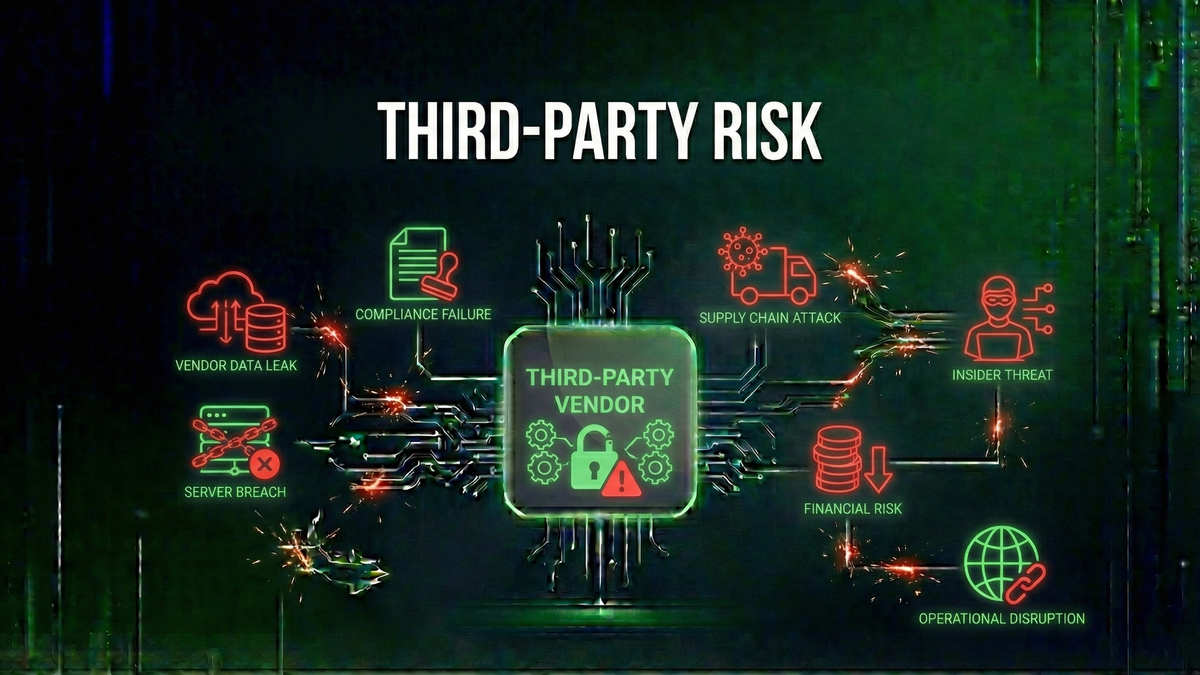
Third-party risk manifests in several ways:
Anatomy of a Third-Party Breach: The 700Credit Case
The 700Credit breach provides a textbook example of how third-party compromises unfold. Understanding this sequence helps illustrate why third-party risk is so difficult to manage:
The result: 5.8 million customer records exposed, including Social Security Numbers. The breach occurred despite 700Credit potentially having strong security controls on their own systems—the weakness was in the integration point with a partner.
The Supply Chain Security Challenge
Third-party risk is closely related to supply chain security, but the supply chain extends beyond your immediate vendors to include their vendors as well—creating layers of risk. Consider a typical business scenario:
A vulnerability at any point in this chain can potentially impact your data. High-profile supply chain attacks like SolarWinds (2020) and Kaseya (2021) demonstrated how attackers can compromise one vendor to gain access to thousands of downstream organizations.
Why Third-Party Risk is Growing
Several factors are making third-party risk an increasingly critical concern:
Cloud Adoption and SaaS Proliferation
The average enterprise now uses hundreds of SaaS applications, each representing a potential third-party risk. These cloud services require data sharing, API integrations, and often have access to sensitive information. The ease of adopting new SaaS tools means third-party relationships are created faster than security teams can assess them.
API-Driven Integration
Modern business applications communicate through APIs, creating countless connection points between organizations. As the 700Credit breach demonstrated, these API connections can become attack vectors when not properly secured. Every API integration extends your security perimeter to include the partner's environment.
Increased Outsourcing
Organizations increasingly outsource critical functions—from IT operations to customer service to financial processing. Each outsourcing relationship means sharing sensitive data with external parties. In the 700Credit case, automotive dealerships outsourced credit checking to 700Credit, who in turn relied on integration partners.
Attacker Sophistication
Cybercriminals have learned that attacking third parties can be more effective than direct attacks on well-defended targets. A smaller vendor may have weaker security but provide access to multiple larger organizations. This "one-to-many" attack model makes third parties attractive targets.
Managing Third-Party Risk: A Framework
Effective third-party risk management requires a structured approach throughout the vendor relationship lifecycle:
Pre-Engagement Assessment
Before engaging a new vendor, conduct due diligence on their security posture. This includes reviewing their security certifications (SOC 2, ISO 27001), conducting security questionnaires, understanding their data handling practices, and assessing their incident response capabilities. The depth of assessment should match the sensitivity of data being shared.
Contractual Protections
Contracts with third parties should include security requirements, audit rights, breach notification requirements, and liability provisions. Critical elements include:
In the 700Credit breach, a key failure was the integration partner's failure to notify 700Credit of their compromise. Strong contractual breach notification requirements could have detected the attack months earlier.
Ongoing Monitoring
Security assessment is not a one-time activity. Organizations should continuously monitor third-party risk through regular security reviews, continuous monitoring of vendor security posture, monitoring dark web and threat intelligence for vendor compromises, and tracking vendor security incidents and responses.
Access Control and Segmentation
Apply the principle of least privilege to third-party access. Vendors should only have access to the minimum data and systems required for their function. Network segmentation can limit the blast radius if a vendor is compromised. API access should be restricted and monitored.
What This Means for Consumers
As an individual, you have limited control over how organizations manage their third-party relationships. However, understanding third-party risk helps you make informed decisions and recognize that data security extends beyond the companies you directly interact with.
When you provide your Social Security Number to a car dealership, that information may be shared with credit bureaus, lenders, fraud detection services, and compliance providers—each introducing additional third-party risk. While you cannot audit these relationships, you can take protective measures like credit freezes that limit the damage from any breach in this chain.
The Future of Third-Party Risk Management
Regulators are increasingly focused on third-party risk. Financial services regulations like the NYDFS Cybersecurity Regulation already require robust vendor risk management programs. The SEC has proposed rules requiring disclosure of cybersecurity risk management practices, including third-party risk. Similar regulations are emerging globally.
Technology is also evolving to address these challenges. Zero-trust architectures that verify every access request can limit the impact of compromised vendors. Continuous security monitoring services provide real-time visibility into vendor security postures. Blockchain and other technologies may eventually enable more transparent and verifiable supply chain security.
Key Takeaways
Third-party risk is an inescapable reality of modern business, but it can be managed. Keep these key points in mind:
Keep Learning
Related Reviews
REOLINK 4K Security Camera System Review: Professional PoE Surveillance at DIY Prices
The REOLINK 4K PoE security system delivers 8MP clarity, smart person/vehicle detection, 24/7 recording with 4TB storage, and plug-and-play installation for comprehensive home surveillance.
Ring Outdoor Cam Pro Review: 4K Security Camera with Radar-Powered Motion Detection
The Ring Outdoor Cam Pro delivers Retinal 4K video, 10x enhanced zoom, Low-Light Sight for true color night vision, and radar-powered 3D motion detection for precise security alerts.
Cisco Duo Review: Enterprise MFA Made Simple
Cisco Duo delivers robust multi-factor authentication with one of the smoothest user experiences in the enterprise MFA space. While pricing can escalate quickly for larger teams, its device trust and adaptive policies make it a solid choice for security-conscious organizations.