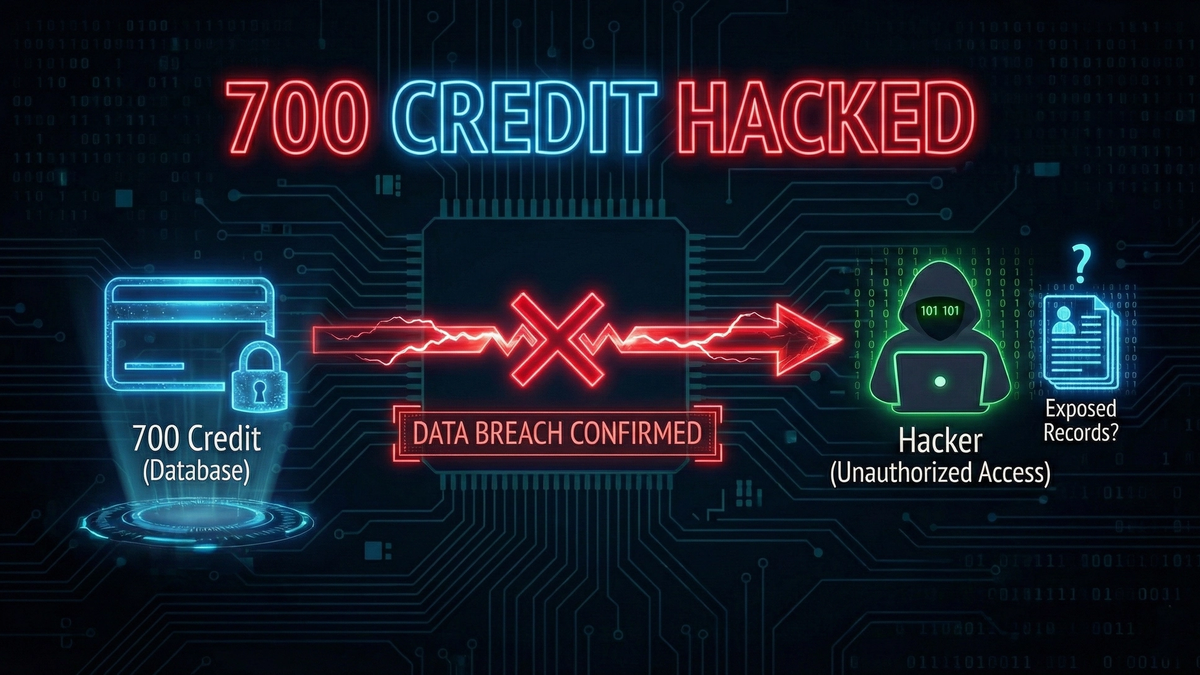
700Credit Data Breach Exposes 5.8 Million Customer Records Through API Vulnerability
700Credit reveals massive data breach affecting 5.8 million people after attackers exploited an API vulnerability through a compromised integration partner.
700Credit, one of the largest credit reporting and identity verification providers for automotive dealerships in the United States, has begun notifying more than 5.8 million individuals that their sensitive personal information was exposed in a significant data breach. The incident, which stemmed from a compromised integration partner and an exploited API vulnerabilityVulnerability🛡️A weakness in software, hardware, or processes that can be exploited by attackers to gain unauthorized access or cause harm., allowed threat actors to exfiltrate customer data over a five-month period before detection.
The breach represents one of the most significant automotive industry data security incidents in recent years, exposing highly sensitive information including Social Security Numbers, dates of birth, and physical addresses of millions of consumers who had their credit checked through automotive dealerships nationwide.
Timeline of the Attack
The cyberattack began in July 2024 when threat actors successfully breached one of 700Credit's integration partners. During this initial compromise, the attackers discovered an API endpoint that provided access to customer information. Critically, the compromised partner failed to notify 700Credit of the security incident, allowing the attackers to operate undetected for months.
According to 700Credit Managing Director Ken Hill, the threat actors exploited a security vulnerability in the API—specifically, a failure to validate consumer reference IDs against the original requester. This type of vulnerability, known in the security industry as Broken Object Level Authorization (BOLA), allowed the attackers to access records they were not authorized to view by manipulating reference identifiers.
The data exfiltrationData Exfiltration🛡️The unauthorized transfer of data from a computer or network, often performed by attackers before deploying ransomware to enable double extortion. continued from May through October 2024, during which approximately 20% of consumer data in the affected systems was copied without authorization. 700Credit did not detect the suspicious activity until October 25, 2024, at which point the company immediately launched an investigation with assistance from third-party computer forensic specialists.
Exposed Data Types and Impact
The investigation confirmed that the following sensitive data types were compromised in the breach:
This combination of data elements is particularly dangerous for victims, as it provides everything needed for identity theft, fraudulent credit applications, and other financial crimes. Social Security Numbers, unlike passwords or credit card numbers, cannot be easily changed, meaning affected individuals face long-term risks from this exposure.
The scale of the breach—5.8 million records—reflects 700Credit's significant market presence. The company provides credit reporting, identity verification, and fraud and compliance services to more than 23,000 automotive, RV, Powersports, and Marine dealers across the United States. Any consumer who applied for financing or had their credit checked at one of these dealerships during the affected period may have had their information compromised.
Technical Analysis: The API Vulnerability
The root cause of this breach highlights a common but critical API security flaw. The vulnerability—a failure to validate consumer reference IDs against the original requester—is classified as Broken Object Level Authorization (BOLA) and consistently ranks as the number one API security risk according to the OWASP API Security Top 10.
In a properly secured API, each request should be validated to ensure the requester has authorization to access the specific data being requested. In this case, the attackers were able to manipulate reference IDs to access customer records belonging to other users—a classic example of insecure direct object reference.
For organizations looking to understand and prevent similar vulnerabilities, proper API security requires implementing robust authorization checks at the object level, not just at the authentication level. Simply verifying that a user is logged in is insufficient—every request must verify that the authenticated user has permission to access the specific resource being requested.
Third-Party RiskThird-Party Risk📖The potential security threats that arise from an organization's relationships with external vendors, suppliers, and partners who have access to systems or data.: The Hidden Attack Vector
This incident underscores the growing threat of supply chain and third-party attacks. The initial compromise did not occur at 700Credit itself but at an integration partner. This partner's failure to disclose the breach created a critical gap in 700Credit's security awareness, allowing the attack to continue undetected for months.
Third-party risk management has become one of the most challenging aspects of modern cybersecurity. Organizations must not only secure their own systems but also ensure that every vendor, partner, and integration point maintains adequate security controls. The 700Credit breach demonstrates how a single weak link in the supply chain can expose millions of customer records.
Contractual requirements for breach notification, regular security assessments of partners, and continuous monitoring of third-party connections are essential components of a comprehensive security program. The failure of the integration partner to promptly notify 700Credit of their compromise significantly extended the window of opportunity for data theft.
Company Response and Remediation
700Credit has taken several steps in response to the breach. The company immediately terminated the exposed API upon discovery and engaged third-party forensic specialists to conduct a thorough investigation. The company has also filed breach notifications with the Federal Trade Commission (FTC) on its own behalf and a consolidated notification on behalf of all affected dealer clients.
This consolidated approach means that dealerships impacted by the breach do not need to file separate notifications with the FTC or state attorneys general—700Credit is handling these regulatory requirements on their behalf. The company has also notified the National Automobile Dealers Association (NADA) to help raise awareness throughout the industry.
A dedicated page on 700Credit's website provides affected individuals with information about the breach and guidance on protective measures. The company is offering 12 months of complimentary identity protectionIdentity Protection🛡️A Microsoft Entra IDMicrosoft Entra ID🛡️Microsoft's cloud-based identity and access management service (formerly Azure Active Directory), providing authentication, SSO, and security features for Microsoft 365Microsoft 365🌐Microsoft's subscription-based cloud productivity suite including Office applications, Exchange Online, SharePoint, and Teams. and other applications. Premium feature that uses machine learning to detect risky sign-ins and user behaviors, automatically enforcing remediation like MFA challenges or password resets. and credit monitoring services through TransUnion, with a 90-day enrollment window for affected individuals.
What Affected Individuals Should Do Now
If you have purchased a vehicle, RV, boat, or powersports equipment through a dealership in the United States, your information may have been exposed in this breach. Here are the immediate steps you should take:
Broader Implications for the Automotive Industry
This breach raises significant questions about data security practices across the automotive retail industry. Car dealerships routinely collect highly sensitive personal information as part of the financing process, yet many may not have the security infrastructure typically found in financial institutions.
The incident also highlights the importance of vendor due diligence. Dealerships trust companies like 700Credit with their customers' most sensitive data. When that trust is violated through a security breach—whether at the primary vendor or a third-party partner—it's ultimately the consumers who bear the consequences.
Industry regulators and consumer protection agencies may increase scrutiny of data handling practices in the automotive sector following this incident. Dealerships should review their data protection agreements with service providers and ensure they have clear breach notification requirements and security audit provisions in place.
Learn More About Protecting Yourself
Understanding the technical aspects of how breaches occur and how to protect yourself is essential in today's digital landscape. To learn more about the concepts discussed in this article, explore our educational resources:
As data breaches continue to grow in scale and sophistication, consumers must remain vigilant and take proactive steps to protect their identities. The 700Credit incident serves as a reminder that sensitive personal information is only as secure as the weakest link in the chain of organizations that handle it.
Frequently Asked Questions
How do I check if my systems are vulnerable?
Review the affected product versions listed in the vendor advisory, check your asset inventory, and use vulnerability scanning tools. CISA's KEV catalog indicates if active exploitation is occurring.
Should I apply the patchPatch🛡️A software update that fixes security vulnerabilities, bugs, or adds improvements to an existing program. immediately?
Critical vulnerabilities with active exploitation should be patched within 24-48 hours. Follow your organization's change management process, but escalate if the vulnerability has a high CVSS score or is being actively exploitedActively Exploited🛡️A vulnerability that attackers are currently using in real-world attacks, requiring immediate patching regardless of severity score..
How can I protect my organization from similar attacks?
Implement defense-in-depth: enable MFA everywhere, maintain offline backups, segment your network, keep systems patched, and train employees on phishing awareness. Monitor for indicators of compromise mentioned in threat advisories.
What should affected users do?
Change passwords for affected accounts, enable MFA, monitor for suspicious activity, consider placing a fraud alert or credit freeze, and watch for phishing attempts exploiting the breach.